
The Last Interviews
I interviewed today with a very large Internet company. For a type of position I’ve never held, with the prospect of making more money than I ever have. The process has taken months. I don’t think my chances of landing the job are particularly high. When I read the JD, I really believe I can do the role. I would love the opportunity to bust my butt to learn it and be successful. But I don’t have a clue what it actually takes to be successful in it. I don’t even know what a day would look like. And I keep wondering - why wouldn’t you just hire someone who has done this exact role for their whole career? I would.
I joke that these are my last interviews. I’ve failed too many times over the last 14 months to keep believing a full-time job is coming. At the same time, AI tooling has gotten more and more capable. I feel simultaneously that organizations don’t need me, and that I don’t need them. If I’m actually capable of getting things done - building and selling - there are fewer and fewer excuses as to why I can’t just go and do it.
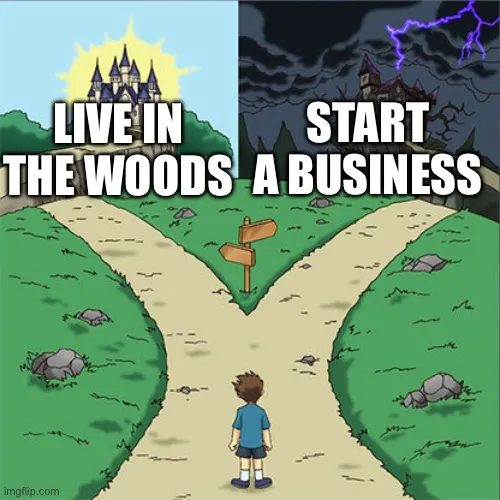
I’m at a fork in the road. I can either live in the woods or I can start a business. Or maybe I can go straight and do both. Either way, I no longer feel that being hired by a firm as an employee for a technical niche is something that is at all feasible.
The Numbers Don’t Lie
It’s not just me. U.S. tech job postings are down 36% from where they were in 2020. Technology companies respond to just 5% of applications. The average hire now draws 180 applicants. And 75% of applications just vanish - no response, no rejection, nothing.
I’ve lived this. I’ve been ghosted after final rounds. I’ve had processes drag on for months only to end in silence. One of the more fascinating findings I’ve come across recently: a Harvard Business Review study found that 60% of executives have already reduced headcount in anticipation of AI’s future impact - while only 2% said those layoffs were tied to AI actually being implemented. Companies are firing people because of what AI might do, not what it’s doing. Meanwhile, just 6% of organizations report meaningful bottom-line impact from their AI initiatives despite $200 billion in global investment.
So the job market is contracting based on a bet. That’s a strange thing to be on the wrong side of.
The Other Side of the Coin
Here’s what makes this moment different from 2010, when I graduated into a dead job market, working at a bar. Back then, if you wanted to build something, you still needed people. You needed a designer, a developer, maybe a marketing person. You needed some capital. The barriers were lower than people thought, but they were real.
Now? A complete tech stack for a solo business runs between $3,000 and $12,000 a year. AI tools are reclaiming 20+ hours a week of work that used to require a team. One person can genuinely handle what used to take five or ten. These aren’t hypotheticals - solo-founded startups hit 36.3% of all new companies in 2025, the highest rate in over 50 years. One solo founder built an AI app builder, hit $1 million in annual recurring revenue three weeks after launch, and sold to Wix for $80 million in cash - six months after starting. No employees. No funding.
I’m not saying that’s me. But the gap between what a capable individual can do and what requires an organization is closing fast. And for someone who learned web development, digital marketing, and business operations by necessity - by just doing it - that shift matters.
What 14 Months Teaches You
When you fail to get hired for over a year, you learn things about yourself that are hard to learn any other way. You learn which rejections actually sting and which ones are a relief. You learn that some of the roles you were chasing weren’t even things you wanted - they were just things that seemed like the next logical step. You learn that the professional world, for all its talk about talent and culture fit, is largely a pattern-matching exercise. And if your pattern doesn’t match, it doesn’t matter how good you are.
But you also learn what you’re capable of when nobody is giving you permission. Over the last 14 months, I’ve built more, learned more, and shipped more than I did in years of full-time employment. Not because I’m more talented now. Because there’s nothing else to do. When the path forward is blocked, you either sit there or you find another one.
That’s the strange gift of rejection at scale. It forces a kind of honesty. If the market is telling you no - repeatedly, clearly, without ambiguity - at some point you have to ask whether the question is wrong, not just the answer.
The Fork
I’ve been here before. When I graduated from UVM in 2010, there was no job waiting for me. I ended up starting Vermont Baseball Tours from a barstool because I saw a problem I could solve. That business never paid me a dime, but the skills I built doing it became my entire career. The work that shaped me the most didn’t come with a salary.
Now I’m back at the same fork, but the terrain has changed. The tools are better. The cost of building is lower. And I’ve done this once before, so I know what the early days feel like - the uncertainty, the financial tightness, the feeling of building something that might not work. I also know what it feels like when it does.
I don’t know yet whether these really are my last interviews. Maybe I get an offer that’s too good to turn down. Maybe I don’t and the decision makes itself. But I do know that the argument for building something of my own has never been stronger, and the argument for waiting around for someone to hire me has never been weaker.
The fork in the road isn’t really about choosing between employment and entrepreneurship. It’s about whether you trust yourself enough to bet on what you can do, or whether you keep asking someone else for permission to do it.